 ML Model
77
ML Model
77
Deepfake Image Detection Using Artificial Intelligence
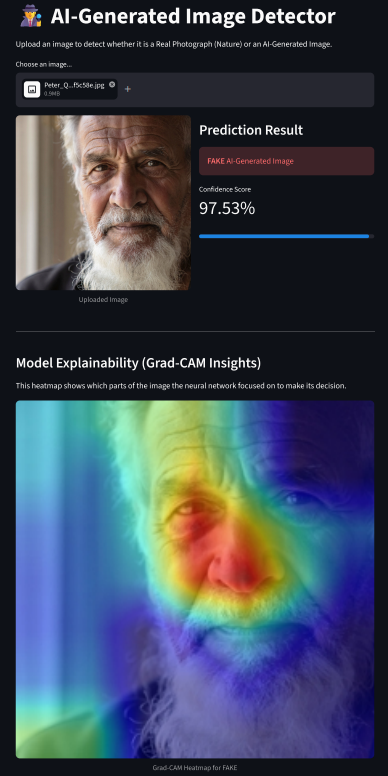
# Deepfake Image Detection Using Artificial Intelligence ## What I Built The speed at which AI can generate photorealistic imagery has massively outpaced the human eye's ability to detect it. This project is an automated **AI-Generated Image Detector**, a binary classification system that takes any image and predicts whether it is a real photograph or machine-generated. More importantly, it doesn't just give a prediction; it explains its reasoning. By integrating **Grad-CAM** (Gradient-weighted Class Activation Mapping), the application generates a heatmap over the uploaded image, highlighting the exact pixels and artifacts the neural network focused on to make its decision. ## Tech Stack & Architecture * **Backbone:** EfficientNet-B0 (Pre-trained on ImageNet for transfer learning) * **Framework:** PyTorch * **Explainability:** Custom Grad-CAM implementation using PyTorch hooks * **Deployment:** Streamlit, Docker, Hugging Face Spaces EfficientNet-B0 was chosen for its compound scaling approach, which provides state-of-the-art accuracy with a highly efficient parameter count (~5.3 million), making it lightweight enough to run inference smoothly in a browser. ## Dataset & Training To ensure the model learns generalized AI artifacts rather than memorizing a specific generator, I curated a dataset of over **45,000 images** from more than 10 different sources: * **FAKE (AI):** DiffusionDB, Synthbuster (Stable Diffusion, DALL·E 2, GLIDE), StyleGAN Faces. * **REAL:** RAISE 4K, Flickr, Imagenette, and the **DPED dataset** (smartphone photos from iPhone/Sony to fix domain shift biases). Crucially, modern generators like **DALL·E 3 and Midjourney v5 were withheld entirely from training** and only used in the test set to evaluate true zero-shot generalization. ## Code Example: Grad-CAM Explainability Instead of using external libraries that can break in headless deployment environments, I implemented Grad-CAM using pure PyTorch forward and backward hooks: ```python import torch import torch.nn.functional as F def generate_gradcam_heatmap(model, input_tensor, target_class): feature_maps, gradients = [], [] target_layer = model.features[-1] # Register hooks to capture activations and gradients handle_f = target_layer.register_forward_hook(lambda m, i, o: feature_maps.append(o)) handle_b = target_layer.register_full_backward_hook(lambda m, gi, go: gradients.append(go[0])) output = model(input_tensor) model.zero_grad() output[0, target_class].backward() handle_f.remove() handle_b.remove() # Global average pooling and heatmap generation weights = torch.mean(gradients[0], dim=(2, 3), keepdim=True) cam = F.relu(torch.sum(weights * feature_maps[0], dim=1).squeeze()) cam = (cam - cam.min()) / (cam.max() - cam.min() + 1e-8) return cam.detach().cpu().numpy()

No projects match
Try a different search or filter