About the project
# Lliuq: A Serverless AI Platform for Accessible Scholarship and Academic Preparation
## What I Built
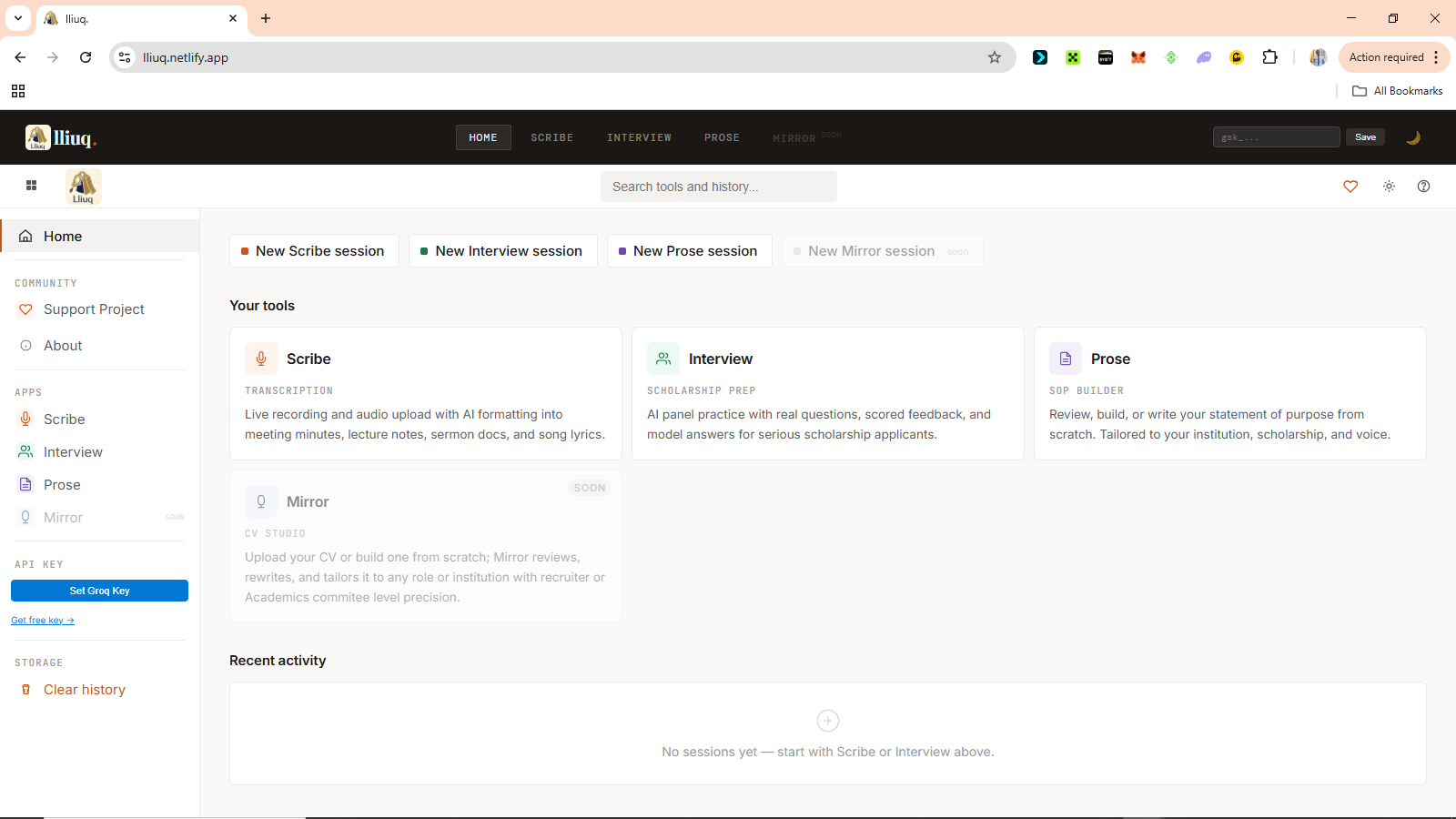
Lliuq is a browser-based suite of AI-powered productivity tools built for one purpose: helping people put their best work forward when it matters most, without a paywall in the way.
I was preparing for a scholarship interview when I hit the third paywall in one night. Every tool that could actually help had a gate in front of it. The help existed. The technology was always there. But what did not exist was access. So I built this and made it free, because the distance between a prepared candidate and an unprepared one should never come down to what they can afford.
That gap is not a minor inconvenience. It is the mechanism through which opportunity reproduces itself in the hands of people who already have it. Lliuq is a direct technical response to that mechanism. Every architectural decision, from the serverless infrastructure to the zero-cost model to the privacy-first data handling, was made with one constraint in mind: the student in Lagos or Accra or Nairobi preparing for a scholarship interview at midnight should have access to the same quality of preparation tools as anyone else, anywhere in the world. That is SDG 4 and SDG 10, not as stated goals but as design requirements written into the first line of code.
The platform currently has three live AI tools with a fourth under development:
1. **Scribe** records audio and produces structured, formatted documents using Whisper and Llama. Not raw text but proper meeting minutes, lecture notes, sermon summaries, and song transcriptions, each with auto-generated metadata including tone classification, estimated reading time, and transcription confidence scoring, so that no key point is lost, action items are clearly noted, and the people in the room can be present in the conversation instead of racing to write it down
2. **Interview** is a scholarship interview simulator. It generates contextual questions across ten distinct categories, scores spoken answers on content depth and grammar, detects filler words in real-time, measures words per minute, and returns model answers alongside three concrete improvement tips. The entire evaluation is returned as structured JSON from Llama and parsed directly in the browser, allowing candidates to identify exactly where they lost points, what they said that weakened their answer, and what a stronger response would have sounded like.
3. **Prose** is a statement of purpose builder with pre-listed support for over 100 universities worldwide, including institutions across Africa, Europe, Asia, and North America, and for any university or scholarship not on the list, the user can type it in manually. It uses Llama to generate and refine application writing tailored to the specific university and programme the user is applying to, because writing with clarity in your first language and writing the kind of statement of purpose that Cambridge or Harvard expects are two entirely different skills, and the gap between them should not be the reason an application fails.
Everything runs entirely in the browser. No account needed. Nothing is stored on any server. The user connects their own free Groq API key, and the platform is ready to use. The platform never touches your key.
## Code Examples
The platform has no backend. Every AI call goes directly from the browser to Groq over HTTPS.
```javascript
const response = await fetch("https://api.groq.com/openai/v1/chat/completions", {
method: "POST",
headers: {
"Authorization": `Bearer ${apiKey}`,
"Content-Type": "application/json"
},
body: JSON.stringify({
model: "llama-3.3-70b-versatile",
messages: conversationHistory,
response_format: { type: "json_object" }
})
});
```
For the Interview module, audio is captured via the browser MediaRecorder API and sent to Groq's Whisper endpoint for transcription before evaluation:
```javascript
const mime = MediaRecorder.isTypeSupported("audio/webm;codecs=opus")
? "audio/webm;codecs=opus"
: "audio/webm";
const recorder = new MediaRecorder(stream, { mimeType: mime });
recorder.onstop = async () => {
const blob = new Blob(allChunks, { type: mime });
const fd = new FormData();
fd.append("file", blob, "audio.webm");
fd.append("model", "whisper-large-v3");
const res = await fetch("https://api.groq.com/openai/v1/audio/transcriptions", {
method: "POST",
headers: { "Authorization": `Bearer ${apiKey}` },
body: fd
});
};
```
The Interview engine enforces non-repetitive questioning through a structured system prompt. Llama tracks which of the ten question categories it has already used and is forbidden from repeating one within a session:
```javascript
const SYSTEM_PROMPT = `
QUESTION VARIETY RULES:
Categories: [opening/motivation, academic achievement, leadership,
community/social impact, adversity/resilience, future vision,
values/ethics, scholarship fit, critical thinking, personal character]
Each question MUST come from a DIFFERENT category than the previous one.
Never ask two questions from the same category in one session.
Make questions specific to the scholarship name, university,
and the field of study provided.
`;
```
Scribe uses a switchable system prompt architecture. The format type the user selects determines which AI persona and output structure loads. A meeting prompt loads a professional secretary persona that produces structured minutes. A lecture prompt loads a Prodigy student persona that generates hierarchical notes with cross-disciplinary connections. The same raw audio produces structurally different documents depending entirely on which system prompt is active.
# Result
1. Lliuq is live at [lliuq.netlify.app](https://lliuq.netlify.app) with no account required. Three functioning tools are now available.
2. The platform proves that a useful, privacy-respecting AI product does not always need a backend, a subscription model, or a company behind it. By routing all inference through the user's own Groq API key and persisting state entirely in localStorage, Lliuq eliminates infrastructure costs at the platform level and passes that zero cost directly to the user. This is what responsible AI for Good looks like when the architecture itself is the commitment.
3. The Interview module delivers five-question sessions with real-time speech scoring across content depth, grammar accuracy, confidence, calmness, and vocal pace, all evaluated by Llama and returned as structured JSON. The Scribe engine produces formatted documents from raw audio using Whisper for transcription and Llama for restructuring. The Prose module generates university-specific application writing using contextual prompts built around the institution and programme the applicant is targeting.
4. Users supplying their API key allow them access to all the tools. The API Key itself comes with a generous allocation of free tokens. The community this platform is built for is the student who cannot afford a coaching session, the applicant who found every free tool behind a trial limit, and the candidate who is every bit as qualified as anyone else in the room but has less time and less money to prepare.
5. Since there is no server, account, or database, the user data stays secured on their local browser storage, and clearing it removes everything.
## Conclusion
The goal was never to build another AI wrapper. It was to make the kind of preparation that changes outcomes available to anyone who needs it, regardless of what they can pay. And it delivers.
 Titilola Kazeem SalisuRobotics Engineer || Medical Robotics Researcher || Agentic AI Developer || AI for Good Advocate
 RAIN
RAIN