About the project
# Kinematic Snake-like Robot for Pipeline Inspection
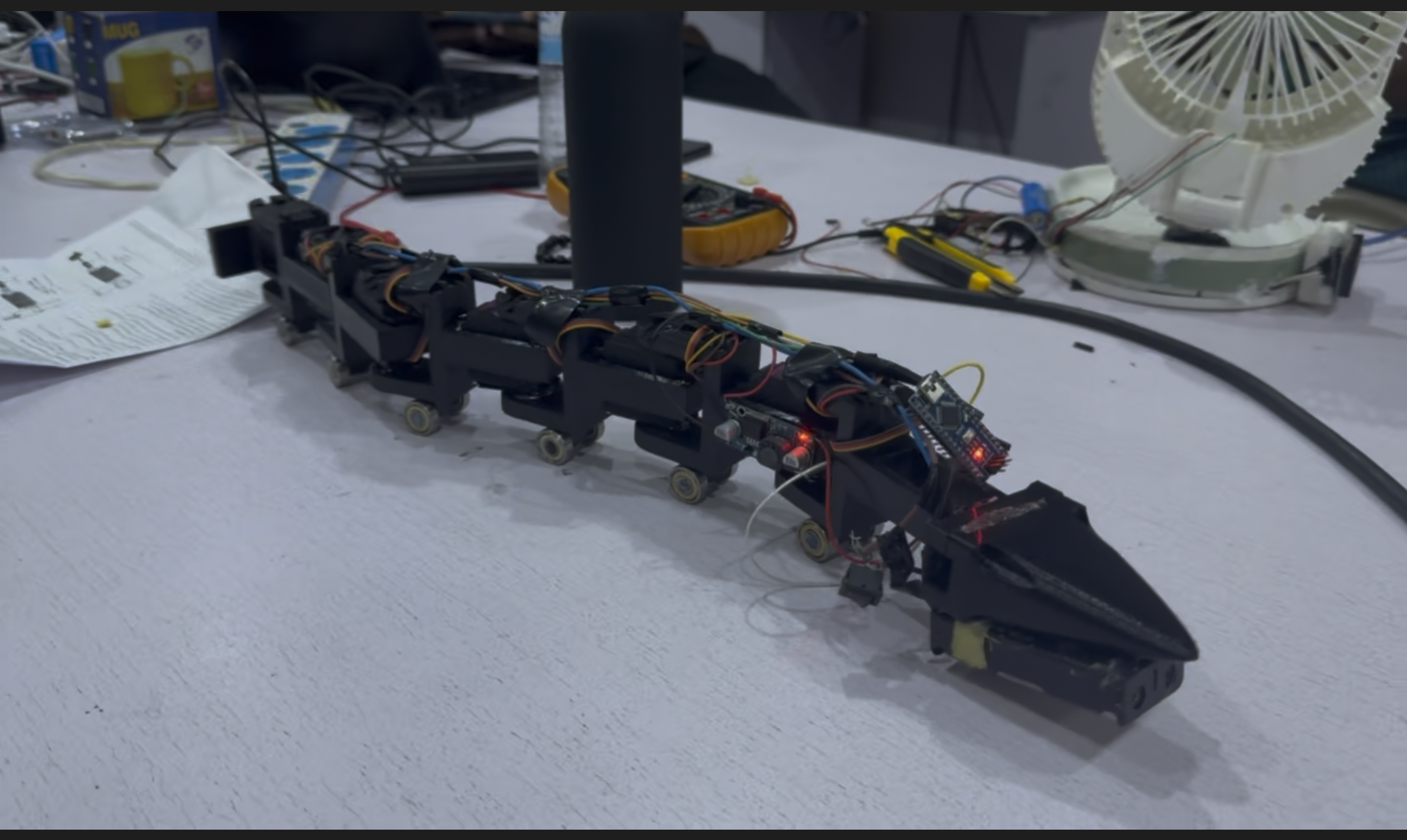
This project explores how to create realistic snake-like locomotion using servo motors and mathematical sine waves.
Instead of manually controlling every joint, the robot generates a travelling wave through its body. This wave propagation produces smooth slithering motion similar to a biological snake.
Articulated snake robots are one of the most interesting forms of bio-inspired robotics. Unlike wheeled robots, snake robots generate movement through coordinated wave propagation along a segmented body. This project demonstrates a simple Arduino implementation of snake locomotion using multiple servo motors and sinusoidal motion control.
The motion algorithm below creates a travelling wave across a chain of servos, producing a slithering effect similar to biological snakes.
The snake’s movement is generated using a sine wave. Each servo receives a slightly phase-shifted version of the same wave, creating the illusion of a wave travelling through the body.
---
## Mathematical Model
Mathematically, the servo angle can be represented as:
θ=90+offset+Asin(ωt+ϕ)
Where:
A = wave amplitude
ω = wave speed
t = time
φ = phase shift between segments
---
## Arduino Implementation
```cpp
// slither snake
void slither(int offset, int Amplitude, int Speed, float Wavelengths) {
MaxAngleDisplacement = abs(offset) + abs(Amplitude);
while (MaxAngleDisplacement > 90) {
Amplitude = abs(Amplitude) - 1;
MaxAngleDisplacement = abs(offset) + Amplitude;
}
for (int i = 0; i < 360; i++) {
rads = i * pi / 180.0;
for (int j = 0; j < 10; j++) {
myServos[j].write(
90 + offset +
Amplitude * sin(
Speed * rads +
j * Wavelengths * Shift
)
);
}
delay(10);
// Check for MQTT updates during motion
client.loop();
// Stop motion immediately if disabled
if (!isSlithering) return;
}
}
```
---
## How the Algorithm Works
The robot generates motion by propagating a sine wave through a chain of servo motors.
Each servo receives:
- the same base wave
- but with a slight phase offset
This phase difference creates a travelling wave across the body, producing smooth serpentine locomotion.
Without the phase shift, all servos would move simultaneously and the robot would simply oscillate in place rather than move forward.
---
## Engineering Challenges
Although the algorithm successfully generates snake-like motion, real-world locomotion depends heavily on mechanical and electrical design.
Important considerations include:
- servo synchronization
- power stability
- directional friction
- joint alignment
- weight distribution
Multiple high-torque servos can generate large current spikes, making stable power delivery critical for reliable operation.
---
## Conclusion
This sine-wave locomotion algorithm demonstrates a simple but effective method for generating articulated snake motion using an Arduino and servo motors.
By introducing phase-shifted sinusoidal control across multiple joints, the robot produces smooth serpentine movement with relatively little code.
The project demonstrates how mathematical wave propagation can be applied to bio-inspired robotics systems for applications such as:
- pipeline inspection
- confined-space exploration
- autonomous inspection systems
 Mofopefoluwa Mofeoluwa AlukoRobotics Engineer.3D Modelling.Building Intelligent Systems



 RAIN
RAIN