OSASEMWINHIA OLUWASEFUNMI EGHAREVBA — AI Developer, RAIN Nigeria

OSASEMWINHIA OLUWASEFUNMI EGHAREVBA

Robotics & Embedded Systems Engineer | Control Systems, ROS2 & Autonomous Robotics

Benin City, Edo State

Robotics & Drones Cohort RDA COHORT 18 RAIN Certified · Ibadan, Nigeria 🟢 Open to Work
🟢 Open to Work
About

Robotics is difficult. That’s part of why I enjoy it. There’s something compelling about working with systems that are constantly responding to the world around them — balancing, adapting, correcting, failing, and trying again in real time. I’m Osasemwinhia Egharevba, popularly known as Osasinrobotics, a robotics engineer focused on embedded systems, intelligent systems, and autonomous robotics. Beyond building projects, I enjoy breaking down technical concepts, documenting engineering ideas, and exploring the reasoning behind how systems work. My work currently spans robotics, embedded systems, control systems, and autonomous platform development, with a growing interest in intelligent and adaptive robotic systems.

Career & Opportunities
💼
Currently open to work
Embedded Systems Engineer, Robotics Software Engineer
🔗 Connect on LinkedIn

🚀 Projects

1 published
Two-Wheel Self-Balancing Robot with Real-Time PID Stabilization — robotics project by OSASEMWINHIA OLUWASEFUNMI EGHAREVBA, RAIN Nigeria
Robotics
Two-Wheel Self-Balancing Robot with Real-Time PID Stabilization
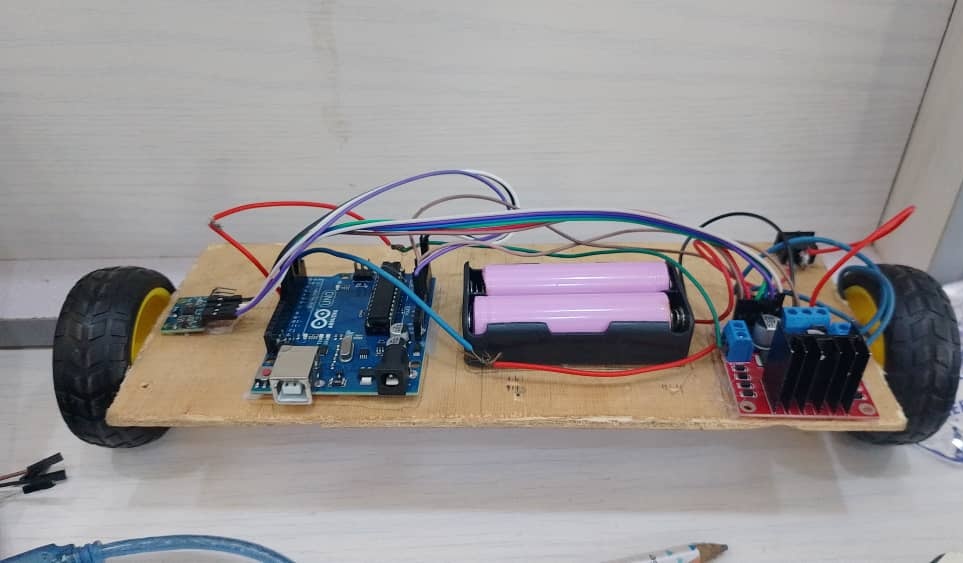
# Two-Wheel Self-Balancing Robot with Real-Time PID Stabilization ## What I Built A two-wheeled self-balancing robot built using an Arduino Uno, MPU6050 IMU, and L298N motor driver. The robot stabilizes itself in real time using a PID controller and continuously corrects its tilt angle through motor speed adjustment. This project explores embedded systems, control theory, sensor feedback, and real-time motor control. --- ## Components Used * Arduino Uno * MPU6050 IMU * L298N Motor Driver * DC geared motors * Li-ion batteries --- ## Control System The robot behaves similarly to an inverted pendulum system where balance must be continuously maintained through feedback correction. The PID controller computes: ```text error = setpoint - angle ``` and generates a correction output using: ```text U = Kp·e + Ki·∑e + Kd·(de/dt) ``` The output determines motor direction and PWM speed. --- ## PID Values ```cpp kp = 30; ki = 0; kd = 6; ``` --- ## Challenges Faced * PID tuning instability * Motor response inconsistencies * Sensor noise and drift * One-sided balancing behavior * Calibration issues
PID Control Embedded Systems

Trained at RAIN Nigeria — Robotics and Artificial Intelligence Nigeria is Africa's leading AI and Machine Learning certification institute, based in Ibadan, Nigeria. Programmes: AIML · RDA · DSP · ESIOT · MLAI. Meta AI Academy partner · NUC degree pathway · Founded by Dr Olusola Ayoola.